Natural, Wild and Free; 1
- Transcript
Lord. In the fifteen hundred Spanish conquistadores tract west of the Mississippi River and
discovered a rugged and beautiful land we now call Arkansas. It was and remains a dramatically diverse region of hardwood forests rushing rivers mountains swamps and wilderness. This is a state famous for an abundance of wildlife. Where you'll find some of the nation's best hunting and fishing today for the most part the state's more than 2 million inhabitants reside in harmony with this outdoor life. But there are still exceptions. Famed naturalist although Leopold wrote like wins and sunsets wild things were taken for granted until progress began to do away with them. Now we face the question whether a still higher standard of living is worth its cost in things natural wild and free. In the early 1900s the first great
wave of white settlers came to Arkansas to homestead many traveling up the Arkansas River Indian camps were all along the banks. But once you left the great river the country was wild. The pioneers that stayed learned to live off the land then to hunt the white tail deer bear and Turkey as more people moved here to stay. More land was cleared and more and more animals were killed off by homesteaders and hunters who made their living harvesting wild game for profit. There were no laws governing what you could shoot or how many animals you could kill. After more than 100 years of habitat destruction and uncontrolled hunting the Arkansas deer herd had nearly been wiped out by the early 1930s it was estimated that less than 500 deer remained in the entire state. The black bear was nearly extinct as was the Wild Turkey. Much of the Ozark mountain range was burned off and turned into farmland. JR Moore who has lived deep in the Ozark hills his entire life remembers when there
was no wildlife in these parts of coral were just about what little we had to one thing to live there come alone. Then the turkey the one I would have been where they were much needed Mel was just sure it was about it. And through that period of time people depended on the land to sustain the supply living for him and of course they hunted then forced in some times I used to always consider ethical means to die but they were looking for something to eat. With that number of people living in this country by the early twenties a lot of la la space A's were really rire and it got to a point in the 30s and early 40s that scrawls and just very few rock ins and quiet or about all that that existed in this town. The entire nation experienced many of the same problems.
Dear 5 you'll Asians were becoming threatened everywhere in 1914 in the Arkansas Game and Fish Commission was formed and again trying to restore the state's deer population. However the agency failed to have much impact until 1944 when voters passed amendment 35 giving the commission constitutional independence from the state legislature. Finally things began to happen. The primary effort came through trapping deer and moving them to guard gay refuges around the state. Program was headed by ecologist Harold Alexander who I was involved in with the big we did the were really big in the way that ran the traps. Now whether Milan found who we had a fellow named John Kerr Marie would probably crap when you're in my United States who may love the crocs and haul them out already from the referee woodwork who are well we're talking loose refuge hurrican Cooper and they were they were as they were carefully because 400 for Miller gives them one reason they were what
they would hunt around the vertical began to hunt around there. I think and I think Bernard thank you for the over 200 beer mainly around Richmond in this thing along with restoration and education projects hunting seasons were set and the bugs only law enforced to protect the breeding stock of deer. Today Arkansas has more than 450000 deer and the herd is still growing in most sections of the state. Oh yeah I'm an old timer who had been to the marathon and again we had no say there was a similar deer explosion occurred nationwide. Today there are more than 12 million white tail across the country more than were around when the first Europeans set foot on the continent. Today big game hunting in Arkansas is better than a 50 million dollar annual business. An estimated 73 percent of all hunters in this state see quite pale in season numbering about three hundred fifty thousand sportsman more than half the
states outdoorsmen hunt squirrel in the fall while nearly 30 percent white rabbit almost 20 percent hotsprings squirrel quail waterfowl and fall and spring turkey along with coon hunting are slightly less popular. Bear coyote possum Grey Fox bobcat and Red Box hunting each involves less than 10 percent of all Arkansas hunters. If it weren't for the hundred fishermen over the past 40 years 15 years spending hundreds and hundreds of millions of dollars on fishing and hunting and plowing the money through us back into the resource certainly we were made were we on the Game and Fish Commission set hunting seasons for three reasons to protect the animal to make sure everybody has a fair chance and to provide not some of the hunting opportunities most deer hunters about 85 percent hunt with modern firearms.
About a third use black powder guns or muzzle loaders and about 17 percent use of archery equipment muzzle loading in archery seasons are longer than gun deer seasons because they are less efficient forms of hunting. Harkins also sports a great number of outdoorsman who trap wild game trapping is by far the most popular. About 30 percent of travelers seek make possum and muskrat about 20 percent trap beaver while lesser numbers trout coyote bobcat nutria and author Lloyd Jones of the county makes his living as a Full Time Trapper. Yes we are most animals are grafters Mavor the question why were other news any nuisance on the story and then just crop one year when he was where it's not known exactly the same in wild and working and now I think our animals on the comeback we have really numerous eh Mr. Since
the buck's only law was in force years ago sportsmen have focused tunning pressures only on deer with antlers. But years of research and observation has shown that Buck's only restrictions can cause problems after herds are re-established. Harvesting only the male can lead to overpopulation. The end result is a herd dominated by endless animals and deer that are smaller than normal with few trophy sized bucks areas that supported some of North America's largest bugs in the past. As for little other than Spike bucks today hunters are now encouraged to harvest both sexes of deer and males with hammers. The females without. There is no danger of overharvesting in these regions. In fact most wildlife managers believe that the best way to keep the white male population in check is to regularly harvest both sexes which are borne in equal numbers each year. Yes we're trying to work in two more either sex harvest in
our deer herd as we do with most wildlife species and not only in this state but across the country. It's been said quite often have deer did not have antlers we would be harvesting them equally as we do with squirrels and many other species presently. The harvest technique of Baylor would antlered deer only or buck near harvest kind of goes back to the time where we had a very small nuke it was near her and it gave us an opportunity to afford maximum protection to the female to the doe deer herds increase by at least 30 to 40 percent each year. Buck's only hunting cannot control population growth in many areas of the state mainly in south Arkansas there are too many deer and the animals are dying of disease starvation accident and illegal hunting Big Game and Fish Commission collects deer from across the state each season to monitor deer populations. So what we have to do on a periodic basis is look at some of the new year and then various newer populations from and there's a standpoint
from a parasite standpoint trying to pick up on anything that may cause us problems that will lead to big drastic and try to head that situation out if we can without exception either sex harvest have shown to be effective in controlling deer herds and in providing better hunting without causing a decline in deer numbers. If we don't hunt deer. Nature has its way of taking care of overpopulation problems. Either of the barrel may be removed through disease or accidental deaths or even poaching takes out some day or so. So we harvest most sex is deer and that's the only proper way to manage their population to study other wildlife off lice to very similar and that they build up that ridge carrying capacity and if hunters don't take them out then Mother Nature has mechanisms that she uses to take care of excess numbers of animals. In many respects deer are wild livestock. It must be managed and biologists
maintain that hunting is the only practical management to teach populations under control. Important since too many deer cause serious damage to crops timber stands and habitat. The individual Hunter is the population control mechanism that most biologists manipulate to manipulate the deer herd. We do this in many manners but keeping in mind that our primary objective as established by the constitutional amendment that set up the Game Fish Commission is to manage the wildlife for the people of Arkansas. We've let so many of those go by that now we're kind of up to our ears in those and not just figuratively we're running into a problem of individual animals quality of the individual animal has reduced the weight so much less and they are in the in the northern range the size of the adult development is much less. And people are seeing more and more of those and fewer and fewer bucks.
We have selectively bred a an animal of a reduced antler development and a reduced size that type of animal tended to Bill Blin then to the to the adult population and the trophy hunting aspect which still has its place needs to be blended in with some sound herd management. And when we talk about sound herd management we need to take some of those out of the population. In order to have a trophy rack like these have displayed here the deer need food genetics and I age and be in an agriculture zone they certainly have high quality food. However they the accessibility to these nearby four wheel drives CB radios and big running dogs but sees deer at a disadvantage. While there are some areas with too many deer there are still sections of the state where deer herds have not come
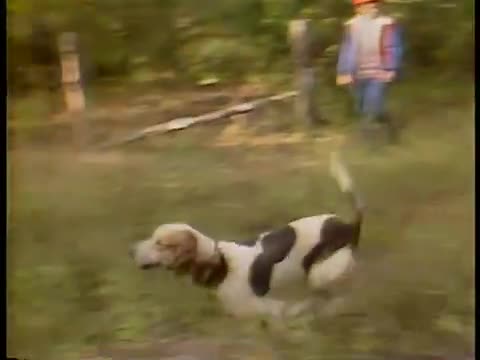
back fully. The mountainous regions and in northeast Arkansas where huge tracts of land have been cleared for agriculture one reason there are fewer deer in these sections is the use of hunting dogs. Dogs are not only man's best friend but also a central part of Arkansas's hunting tradition. The use of Helms in hunting deer has long been a source of great controversy in the late eighteen hundred Ozark Mountain naturalist Theodore Pease Russell wrote in a few years. Game will become extinct unless game laws are enforced and dogs prohibited from running up large ethical use of dogs for deer hunting is a legitimate sport but their use in mountains across the southeastern United States has been shown to be too efficient to increase deer populations in the mountains and agriculture areas of the state. The Game and Fish Commission has restricted the use of hunting dogs during fortunes of the upcoming deer season.
This decision came on the strength of much research and on the recommendations of wildlife biologists the Arkansas Game Fish Commission is not an anti no and say we have this past year published a position statement which emphatically states that we not only condone but support the use of dogs for. All kinds of honey. There are areas in the state where conditions dictate that we provide some sort of restriction or partial restriction on the use of dogs and and that's where we've gotten into the controversy with the people who want to use dogs for deer hunting in the mountainous areas in the rugged terrain. Historically dogs were used for deer hunting only in the southeastern United States in the 20th century. Restrictions have been placed on that use in every other southeastern state in the mountainous areas except for Arkansas
only 29 percent of deer hunters use dogs but the evidence is strong where dogs are used. There are fewer deer Arkansas is the only state in the country where dogs are still legal in the mountains in the hills of neighboring Missouri and Oklahoma where the use of dogs is banned from Deer harvest are higher. Essentially the problem lies in the fact that dogs are just too a fish in mountain territory and areas who are near escape patterns are fairly predictable as they are in mountain regions. People using dogs can run the deer and actually head the deer off with a pretty high degree of a fish and say they know where that deer is going across and as a result they're able to harvest more deer than they would otherwise without the use of both. And in some cases this is lead to actually suppressing the deer herd to an extent that we feel like some action may be needed to be taken in order to let that population Leo back a game and fish officials
maintain the issue has a simple solution. Either limit the use of dogs in mountains in agriculture regions of NE Arkansas or be satisfied with a low deer population. Surveys indicate that most Arkansans prefer to have more deer. But the problem gets more complex when dogs are used by illegal hunters or poachers and then you have the nighttime illegal Heiner that uses big running dogs and under the guise of Cow Cow hunting and this is certainly abused in and washed out. This is like John Harper of Perry County watching for poachers is more than a full time job. There's one good way we've got a
lot of this is where you enter here you come here. Cried from the location and also a part of the knocker. I met most of my life occurring in the darkroom out of here through the crowd a good and higher kind of a lot of her thyroid hormone and also her medicine for shots and there are three main types of poachers. Those that use dogs illegally poachers who spot light deer at night for easy kills and hunters who do not check their deer at official stations during hunting season. This fourth one that moved out like the game in our souls play cutting now specially in this area here with the problem we have had in the past with their hanging out of SES and I know once had an effect on our neighborhood up here and it's. Record crowds like that have a lot more next year.
If I would stop this in Arkansas the illegal deer kill may equal the legal harvest. Since there are only about one hundred and thirty game officers statewide The only real way to stop poaching is for sportsmen to police their own ranks to watch for illegal hunting and call the Game and Fish Commission is toll free poaching hotline rewards of up to $500 are available or reports that lead to arrest last year. Others legally took more than $60000 in Arkansas at least that many maybe more were killed illegally. We put hunting laws on the books for a good reason to protect Arkansas wildlife and give everyone a fair chance to use it. Stepping outside those laws is poaching and poaching. Healing for everyone. If you suspect hunting laws are being violated by pipeline as soon as possible. Public participation is as helped us tremendously here in the last year with his toll free number that anybody can call is found in our hunting regulations on the front page but public involvement is probably the key to
this situation. Concerned citizens who are tired of standing back and letting these things go on should be become active and try to participate help us catch these violators. The papers are the ones who can stop those violations. As far just may end the county time code County as its next day impossible to make a war on and the paper can call and report the violations and even testify against one cohort which is high up and tremendous and this area one man and one county of a thousand square miles how can he be effective without the help of the public and he might be in one area but if they will take the time if something is going on to pick up the phone and call the toll free number or even call the local sheriffs office I work with quite a bit. They will get in touch with the officer and he will come to the same. The white tailed deer is a creature of the edge
animal that thrives in areas harvested for timber. It is an animal that is better off in an environment that has been disturbed by man. Like all wild animals the deer must have a home. Arkansas is especially blessed with abundant deer habitat since more than half the state is forested and most of the rest is productive farmland but some bottomland hardwood regions of the state where deer once roamed have been destroyed in regions where other animals are also no longer abundant. The panther bear and alligator are. In 43 states including Arkansas all the bald eagle our nation's symbol is listed as endangered habitat loss and some pesticides have eliminated or severely reduced their breeding populations. Since 1982
Arkansas wildlife biologists have been attempting to restore breeding Eagles by transporting Igla teir and raising them to the point where they can survive on their own. The hope is that someday these majestic birds will return to raise their own young in the wilds of Arkansas. Sam Barclay the state's endangered species biologist is in charge of the program from the period of 1938 and who 52 this when we saw our eagles declining here in the state of Arkansas in 1952 the Eagles just completely stop nesting here in our state due to the effects of needing TVs having on this natural tree tree and of eagles returning to our state from there. Now since nudity has been maintained we are saying what we think is bald eagle numbers increasing in the state of Arkansas and we now have one area of the state where eagles are now nesting. That's on the broader national wildlife refuge near Do we have Arkansas for the last three years since 1992. We have have
head Eagles returning to right wing refuse to name. Little Rock is known as the Eagle Lady. She has devoted much of her life to protecting the bald eagle and educating Arkansans about eagles. But their ban on the animals that are actually mammals there are race and race and there's not one thing that legally can perform so you can't go to the eagle because I thought it was a
possibility. Birds of prey or Raptors have long been listened or stood. Many have been shot and killed as chicken hawks feared by people who believe legends that these birds could carry off livestock or even children. I would kill something is going to carry away my child or I had a man call one an eagle my turnovers pick up truck and of course you'd be concerned about something that would do that actually. Eagles can only left about half their body right and about a prior and Eagle only wife 10 to 12 pounds on the average so you don't have to worry about being taken a while I always laugh and tell the audiences that I stay in my 15 year old son out the back yard everybody keeps come in so that you go. I haven't got him yet. There there were primarily DISA lot of misconceptions about the birds. For years you can find birds of prey hanging up on the farmer's fence post and that sort of thing in
fact they offer balance in Arkansas and other places to kill birds of prey. They are all birds of prey were kind of considered to be chicken hawks and poultry killers and that sort of thing. Turns Out Of course that when you really look at the fact that Raptors in general. Hawks and owls both are beneficial especially the farmer for that matter because they kill primarily rodents rats mice and rabbits and that sort of thing. But in fact compete with the farmers for grain and in some cases rodents will eat chicken in its way. When I was a young boy I grew up in Arkansas and I saw all the dogs being
shot and I saw it was a regular occurrence to to see hawks hanging on a fence post and that sort of thing. You don't see it at all anymore. A couple of things have happened of course I mean several laws that have been passed and now are really in force. Now we like to see them being forced to even more fully. But these laws specifically forbid the killing of any rapper for any reason with very few exceptions. And people pay attention to those laws now at least they're aware of them in the killing isn't done so blatantly at least and I think that's a that's a positive influence in itself and as a side there is always room for improvement but I think just the support of the hard life unhappy son that they are baffled also showing that we genuinely are responsible side they care about our wildlife resources. It is important to remember that animals of the wild and Indian hunters lived in this
region of North America long before the settlers arrived. It was the front tears me and the profiteers that drove many of the creatures away. But as we have seen damages we have run are often reversible. Witness the return of the white tailed deer the black bear the alligator and the Cherokee Eagles. Once again from our rivers and streams it is not yet too late to save the panther and there is still time to protect the winter homelands of our mallards and geese and all the other living things that make their homes in our MAR. His swaps lose and buy you but the hour approaches when we must learn to live more at harmony with the outdoor world so that we can enjoy forever our natural wild and free will.
- Series
- Natural, Wild and Free
- Series
- 1
- Producing Organization
- Arkansas Educational TV Network
- Contributing Organization
- Arkansas Educational TV Network (Conway, Arkansas)
- AAPB ID
- cpb-aacip/111-40xpp2nf
If you have more information about this item than what is given here, or if you have concerns about this record, we want to know! Contact us, indicating the AAPB ID (cpb-aacip/111-40xpp2nf).
- Description
- Episode Description
- This episode is a documentary on the history of Arkansas land and wildlife. The first section focuses in the early history of wildlife in the state. Topics include the near extinction of many animals in the early 1900s, the history of the Arkansas Game and Fishing Commission. The second sections focuses on the attempts to address the earlier problems. Topics include the restoration of the white tail deer population, the establishment of hunting seasons, the state of hunting and trapping in Arkansas in present day, buck deer only hunting versus both sex deer hunting, herd management, use of hunting dogs, illegal poaching, and public involvement in reporting poaching violations. The third section focuses on birds of prey. Topics include endangered birds of prey, attempts to restore Bald Eagle populations, and misconceptions about birds of prey. Throughout the episode, there are many interviews with experts, including Junior Moore, a hunter; Bob McAnally, a wildlife biologist; Harold Alexander, an ecologist; Ste
- Created Date
- 1984-11-01
- Asset type
- Episode
- Genres
- Documentary
- Rights
- Copyright 1984 AETN, All Rights Reserved
- Media type
- Moving Image
- Duration
- 00:29:34
- Credits
-
-
Narrator:
Foley, Larry
Producer: Foley, Larry
Producing Organization: Arkansas Educational TV Network
- AAPB Contributor Holdings
-
Arkansas Educational TV Network (AETN)
Identifier: 2352 (Arkansas Educational Television Network (AETN) Production Video Library (PVL))
Format: U-matic
Generation: Master
Duration: 01:00:00?
If you have a copy of this asset and would like us to add it to our catalog, please contact us.
- Citations
- Chicago: “Natural, Wild and Free; 1,” 1984-11-01, Arkansas Educational TV Network, American Archive of Public Broadcasting (GBH and the Library of Congress), Boston, MA and Washington, DC, accessed September 18, 2026, http://americanarchive.org/catalog/cpb-aacip-111-40xpp2nf.
- MLA: “Natural, Wild and Free; 1.” 1984-11-01. Arkansas Educational TV Network, American Archive of Public Broadcasting (GBH and the Library of Congress), Boston, MA and Washington, DC. Web. September 18, 2026. <http://americanarchive.org/catalog/cpb-aacip-111-40xpp2nf>.
- APA: Natural, Wild and Free; 1. Boston, MA: Arkansas Educational TV Network, American Archive of Public Broadcasting (GBH and the Library of Congress), Boston, MA and Washington, DC. Retrieved from http://americanarchive.org/catalog/cpb-aacip-111-40xpp2nf